
BPC-157: The Complete Guide to the Most Popular Healing Peptide
BPC-157 is the most-discussed healing peptide in wellness circles. This guide covers what it is, how it works, what the research shows, dosing in trials, and its legal status in 2026.
5/11/20268 min read
Safety, Side Effects, and Legal Status
Reported side effects
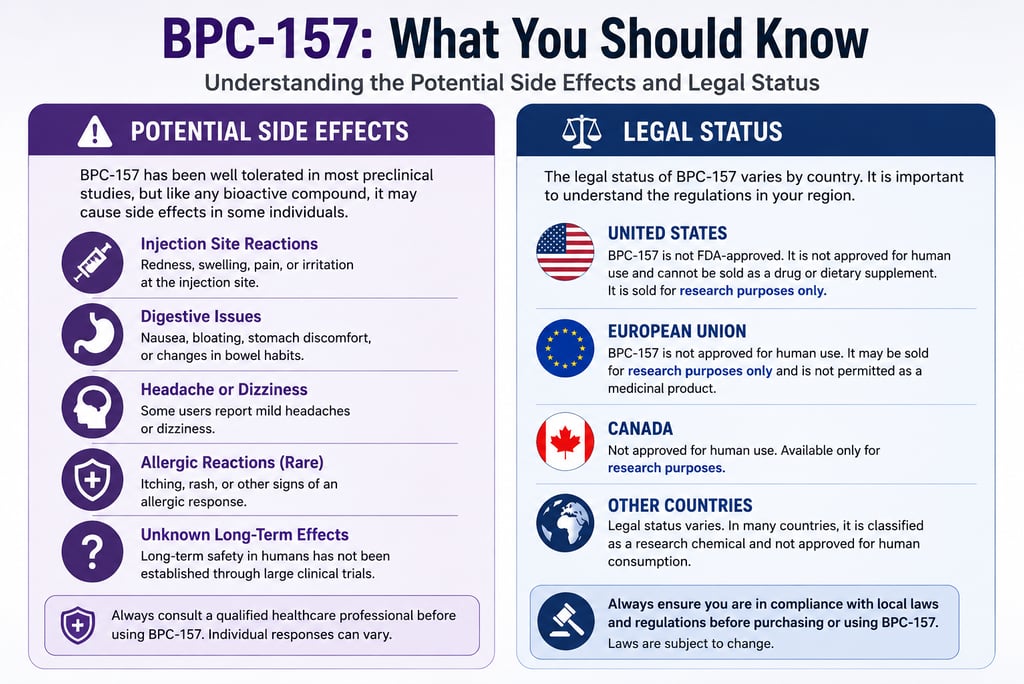
BPC-157 has a relatively clean side-effect profile in published animal studies — no significant toxicity has been reported even at doses far above what humans typically use. In real-world human use, reports include mild injection-site irritation, occasional fatigue, dizziness, headache, and nausea. Serious adverse events appear rare, but the absence of large controlled trials means the long-term safety picture is genuinely incomplete.
What is not yet known is whether long-term use over months or years produces effects that short-term studies miss. Most animal experiments run for weeks; chronic human use spans far longer. Until properly powered human trials are conducted, anyone using BPC-157 is, in effect, generating their own n-of-one data, which is one more reason to do so under medical supervision rather than on their own.
Drug interactions and contraindications
Because BPC-157 is thought to promote tissue growth and angiogenesis, it is generally avoided in people with active cancers — anything that stimulates cell proliferation could theoretically accelerate disease. Pregnant or nursing individuals should also avoid it due to a complete lack of safety data. People on anticoagulants or with significant cardiovascular conditions should only consider it under physician supervision.
Legal status in 2026
BPC-157 is not FDA-approved as a finished pharmaceutical drug. The FDA has been actively reviewing peptide reclassification, and in 2025–2026 introduced restrictions on what compounding pharmacies can prepare — narrowing the legal grey area BPC-157 has occupied. Importing BPC-157 for personal use, or buying it from research-chemical suppliers sits outside any regulatory protection. The legal landscape is changing quickly; verify the current status before assuming any product is properly sourced.
Table of Contents
• What Is BPC-157?
• How BPC-157 Is Believed to Work
• What the Research Actually Shows
• Reported Uses and Benefits
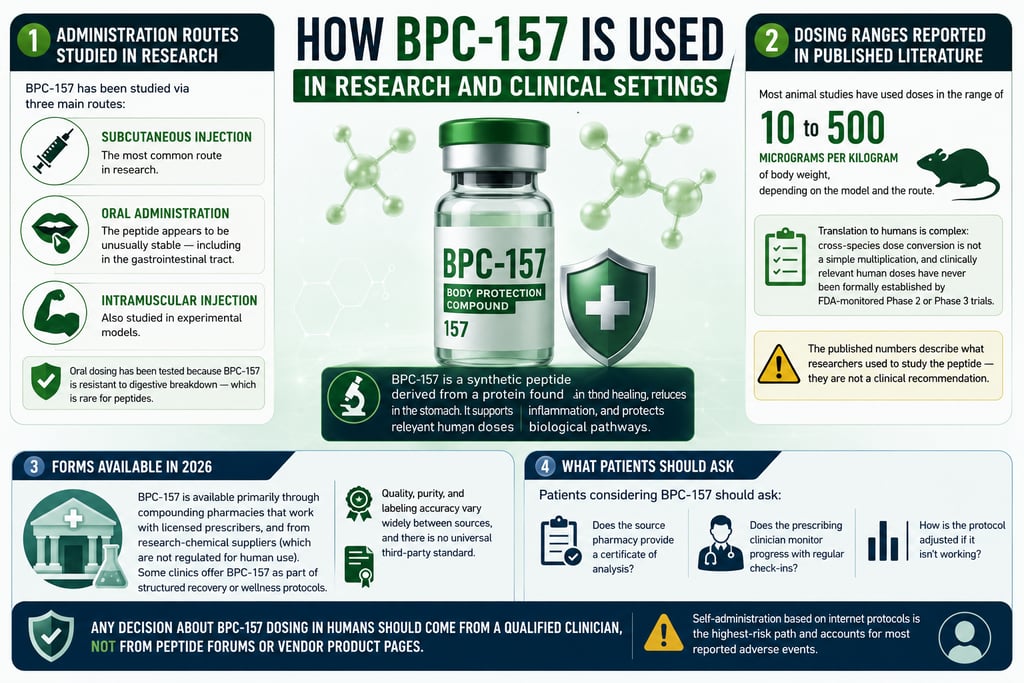
• How BPC-157 Is Used in Research and Clinical Settings
• Safety, Side Effects, and Legal Status
• Frequently Asked Questions
• The Bottom Line
Introduction
BPC-157 is one of the most-discussed peptides in wellness and recovery circles — and for good reason. Athletes, post-surgical patients, and people with chronic gut issues have all gravitated to it because of one shared appeal: a reputation for accelerating healing. The peptide is small, naturally derived, and the early research has produced striking results in animals.
But there is a real gap between hype and evidence. Most of what people read about BPC-157 online comes from animal studies, anecdotal accounts, or peptide-community discussion forums. Rigorous human clinical trials are still limited, and the peptide sits in a regulatory grey area in the United States.
This guide explains what BPC-157 actually is, what the science genuinely supports, how it has been used in research and clinical settings, what the dosing literature looks like, what the realistic risks are, and where its legal status stands in 2026. The goal is not to sell BPC-157 as a miracle — it's to give you a clear, honest picture so you can have an informed conversation with a qualified clinician.
What Is BPC-157?
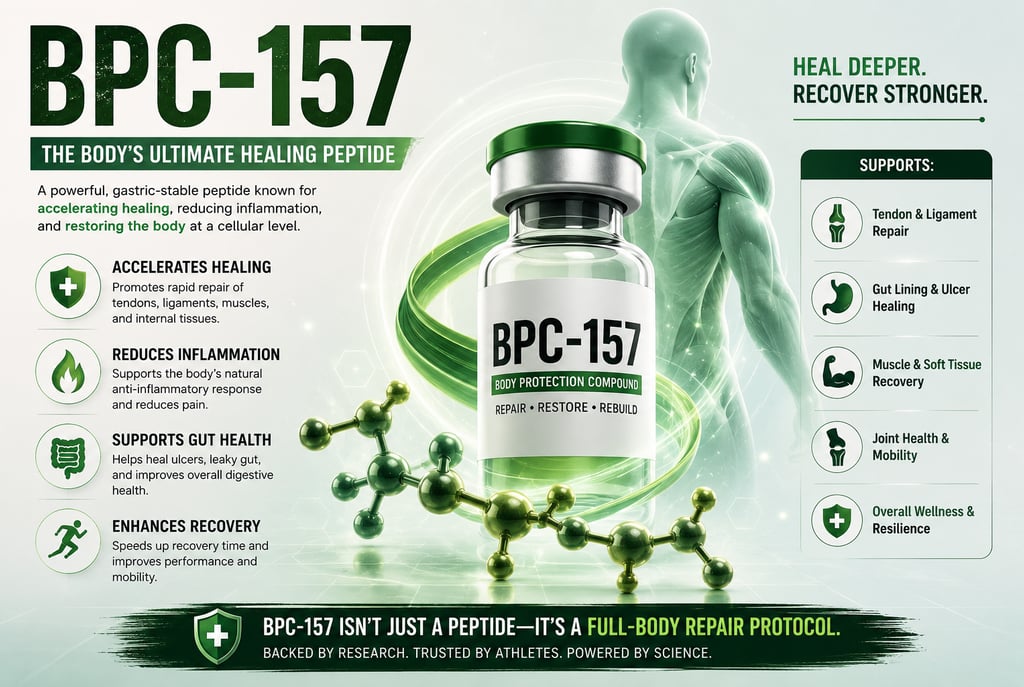
BPC-157 stands for "Body Protective Compound 157." It's a 15-amino-acid peptide — short, stable, and synthetic — that was originally isolated from a larger protein found in human gastric juice. Researchers in Croatia first described it in the 1990s as part of work on stomach protection and ulcer healing, and the peptide-research community has been studying it ever since.
BPC-157 is not a hormone, not a steroid, and not a drug in the traditional sense. It is a short peptide that appears to act as a signaling molecule — telling cells, particularly those involved in healing and inflammation, to behave the way they would in a more favorable biological environment. Its origin in gastric juice is part of why early research focused on gut and tissue repair.
How BPC-157 Is Believed to Work
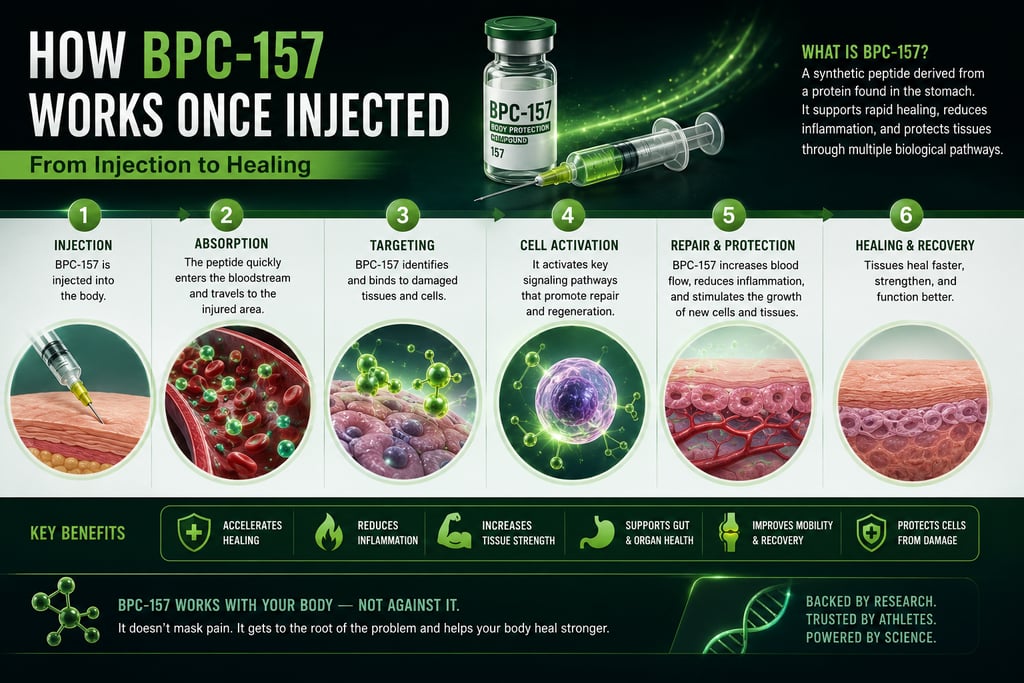
BPC-157's mechanism is not fully mapped, but several pathways have shown up consistently across preclinical research.
Promoting blood vessel growth (angiogenesis)
Multiple animal studies suggest BPC-157 stimulates the formation of new blood vessels around injured tissue. This is significant because injuries to tendons, ligaments, and the gut lining heal slowly, partly because they have limited blood supply. By improving local blood flow, the peptide may help repair processes the body would normally struggle to complete on its own.
Modulating inflammation
Rather than blocking inflammation outright, BPC-157 appears to regulate it — calming chronic inflammation while still allowing the acute healing response. Animal studies have shown reduced inflammatory markers in models of inflammatory bowel disease, joint injury, and burn wounds.
Interacting with growth factors and the nitric oxide system
BPC-157 seems to interact with growth factor pathways (like VEGF) and the nitric oxide system, both of which are central to tissue repair and vascular health. This is the most plausible explanation for the broad range of effects reported in animal models — repair processes share these underlying signaling pathways
What the Research Actually Shows
Almost all of the rigorous research on BPC-157 is in animals. Studies in rats and mice have shown accelerated healing of tendon injuries, faster recovery from gastric ulcers, repair of intestinal anastomoses, protection against NSAID-induced gut damage, and improvements in models of inflammatory bowel disease.
These results are consistent and have been replicated by multiple independent labs, which is more than can be said for many trending compounds. The animal data are genuinely impressive.
Human evidence is much thinner. A small number of early-phase human studies and case series exist, primarily exploring oral BPC-157 for inflammatory bowel disease, but these are limited in size, design, and duration. There are no large randomized, placebo-controlled trials in humans of the kind that establish whether a treatment really works.
This matters. A peptide that performs well in rodent injury models does not always translate cleanly to humans. Honest reporting on BPC-157 should reflect that gap — promising preclinical signal, limited human data, and a need for proper trials before strong claims are reasonable.
Reported Uses and Benefits
Practitioners and users have reported a wide range of benefits, but the evidence base behind each varies. Below are the most commonly cited uses, ranked roughly by how strongly the preclinical literature supports them.
Tendon, ligament, and joint healing
This is the most studied use case. Animal models of Achilles tendon transection have repeatedly shown faster healing with BPC-157 administration — improved tissue strength, faster collagen deposition, and better outgrowth of cells from the injured tendon. Similar effects have been seen in ligament and muscle injury models, with measurable improvements in mechanical properties just one to two weeks after starting treatment. Athletes and post-surgical patients have adopted it for the same reason, though human evidence remains primarily anecdotal.
Gut health and ulcer protection
BPC-157's original research focus was on the digestive tract, and the data here are some of the strongest preclinically. Studies in rodents show protection against NSAID-induced ulcers, accelerated healing of gastric and intestinal damage, and improvements in colitis-like disease. Some users with inflammatory bowel disease report symptom relief, though again, controlled human trials are limited.
Anti-inflammatory and recovery support
Beyond specific tissues, BPC-157 has been associated with broader recovery effects: improved healing after burns, reduced inflammation in muscle injury models, and faster bone repair in fracture studies. These reports are largely from animal research and self-reported use.
Brain and mood (very early evidence)
Preliminary animal research has explored BPC-157's effects on brain injury, antidepressant-like behavior, and dopamine signaling. This area is genuinely speculative — interesting enough to track, far too early to act on. Researchers note that the gut–brain axis is one possible explanation for these effects, since BPC-157 originated in gastric tissue and gut signaling has well-documented influences on mood and cognition.
Frequently asked questions
Frequently Asked Questions
Q1: Does BPC-157 actually work in humans?
The honest answer is: probably some, but the human evidence is far thinner than the marketing implies. Animal data are consistent and impressive, particularly for tendon healing and gut protection. Human use is largely anecdotal, with very limited controlled trials. Approach it as promising rather than proven.
Q2: Is BPC-157 legal in the United States?
BPC-157 is not FDA-approved as a drug. It has historically been available through compounding pharmacies with a prescription, but FDA reclassification efforts in 2025–2026 have narrowed that pathway. Buying from research suppliers is technically not for human use. Always check the latest legal status before purchasing.
Q3: How is BPC-157 typically administered?
In published research, the most common routes are subcutaneous injection and oral administration. The peptide appears unusually stable in the digestive tract, making oral dosing more viable than for most peptides. Specific protocols vary widely, and self-administered use carries real risks — supervised use only.
Q4: How long does it take to see results?
In animal studies, healing improvements were measurable within one to four weeks of starting BPC-157. In human anecdotal reports, users describe noticing changes in tendon or gut symptoms over a similar timeframe. Long-term, sustained use lacks rigorous human safety data.
Q5: Is BPC-157 a steroid or banned in sports?
BPC-157 is not a steroid — it's a short peptide. However, it is on the World Anti-Doping Agency's prohibited list as a non-approved substance. Athletes subject to drug testing should not use it. For non-tested individuals, the question is medical and legal rather than competitive.
Q6: What are the biggest risks of using BPC-157?
The biggest risks are not the peptide itself, but the supply chain and legal status. Unregulated sources can contain contamination, incorrect doses, or different compounds entirely. Self-prescribed use without medical supervision carries the highest risk profile. [INTERNAL LINK: Peptide safety guide — Post 8][Your Brand Name] is a [brief description of your business or service]. We are passionate about [your mission statement].
The Bottom Line
BPC-157 is one of the most interesting peptides in the recovery and healing space — backed by strong preclinical research, modest human evidence, and a regulatory landscape that is shifting underneath it. Promising is the right word; proven is not. For people considering BPC-157, the smartest approach is to work with a qualified medical provider, use only properly compounded sources, and treat it as one tool in a recovery strategy rather than a guaranteed solution.
Continue with our science-backed guide to peptide therapy [INTERNAL LINK: Peptide therapy guide — Post 1], the deep dive on GHK-Cu and skin peptides [INTERNAL LINK: GHK-Cu guide — Post 4], and the practical guide to peptide safety, sourcing, and clinicians [INTERNAL LINK: Peptide safety guide — Post 8].
Sources & Further Reading
All references below are real, peer-reviewed papers, regulatory documents, or organizational sources. Verify the most current versions before publishing.
[1] Sikiric P, Seiwerth S, Rucman R, et al.. “Stable gastric pentadecapeptide BPC 157: novel therapy in gastrointestinal tract.” Current Pharmaceutical Design, 2010.
[2] Chang CH, Tsai WC, Hsu YH, Pang JHS. “Pentadecapeptide BPC 157 enhances the growth hormone receptor expression in tendon fibroblasts.” Molecules, 2014.
[3] Sikiric P, Seiwerth S, Rucman R, et al.. “Brain-Gut Axis and Pentadecapeptide BPC 157.” Current Neuropharmacology, 2016.
[4] Seiwerth S, Brcic L, Vuletic LB, et al.. “BPC 157 and Standard Angiogenic Growth Factors. Gastrointestinal Tract Healing, Lessons from Tendon, Ligament, Muscle and Bone Healing.” Current Pharmaceutical Design, 2018.
[5] “World Anti-Doping Code International Standard: Prohibited List.” World Anti-Doping Agency. wada-ama.org
[6] “Bulk Drug Substances Nominated for Use in Compounding Under Section 503A — Category 2.” U.S. Food and Drug Administration. fda.gov
[7] “PubMed.” U.S. National Library of Medicine, NIH. pubmed.ncbi.nlm.nih.gov